Ski resort directions
One issue that always comes up when skiing or snowboarding is how to get to another part of the mountain.  Ski resorts hand out pocket-sized maps, and big maps are available at the top of most ski lifts.  But planning a route down the mountain rarely goes as desired.  It's often hard to see which trails are linked to each other, and it's sometimes even hard to tell which direction certain trails travel.  A simple solution would be to have an app that could give you directions like Google Maps:  "Go on this trail, turn right at the intersection, take the second lift up to the summit," etc.  It could even have an option for avoiding flat areas, which are the bane of every snowboarder's existence.  Several ski resorts already have apps that tell you the wait time at different lift lines, and cell service at most mountains is now pretty standard.  I'll be waiting for this to appear in the coming years. #sports

Luck in competition
The concept of luck comes up in competition sometimes, like "That was a lucky shot," or "He got knocked out by a lucky punch."  I think the general consensus is that there's no such thing as a lucky shot or a lucky punch.  You could say luck had almost nothing to do with it.  Plus, calling it lucky detracts from the hours and hours of practice and perfection and skill that went into that one event.  It's not just insulting to call it lucky.  It's ignorant. 

But I think there's a deeper level of luck involved in some cases.  Not luck in the sense that a random action was taken at a random time and happened to produce a positive result.  But rather that a series of well-executed actions took place in the exact right order and produced a positive result.  The shot itself wasn't lucky, but it was predicated on the precise timing and exact positioning of the previous event, which itself benefitted from similarly perfect preceding events.  The final result is like a series of probabilities multiplied together:  70% chance of the first event succeeding, 50% chance of the second event succeeding, 20% chance of the third event succeeding = 0.7*0.5*0.2 = 0.07 or 7% overall chance of all events succeeding.  A probability like 7% looks like luck, and it sort of is.  But it's much more than that. #sports

UFC then and now
I started watching UFC in 2006, and back then as well as for the following several years, the UFC was a bit like college football:  Week in and week out, you never knew what to expect.  Both opponents were expected to be at roughly the same skill level and physical ability, but in actuality the fights were often one-sided, and surprisingly so.  This was almost expectable in a sense, because it was a relatively new sport, and fighters were still figuring out which techniques worked (grappling and kickboxing) and which didn't (traditional martial arts). 

The UFC has evolved quickly since then, and to continue the analogy, it's now a bit like professional football:  Week in and week out, you have a pretty good idea of what to expect.  Fighters are fairly evenly matched.  There's rarely a standout that destroys everyone they encounter.  Most fights at the highest level are back-and-forth, skill vs. skill.  It's boring at times, but it definitely has its place. 

But sometimes, just like in the NFL (undefeated Broncos getting shut out for three quarters before benching their record-setting quartback) some fights don't go as expected (newcomer Holly Holm knocks out undefeated submission artist Ronda Rousey). #sports

Tough Mudder (1)
I just ran my first Tough Mudder yesterday.  For the uninitiated, it's a 10-ish mile obstacle run through mud.  The obstacles are things like walls and ramps that require teamwork to complete.  It's not really a competition unless you want it to be.  My five-person team completed it in around 3.5 hours. 

My first observation is this:  Damn, white people sure do like their mud runs.  This is something I first noticed a few years ago.  The Tough Mudder came to town, and then a bunch of mom-and-pop races followed suit.  And I don't know if it's because of the demographic in my area or the friends I have on Facebook, but it seems like the only people who do mud runs are white.  Not that there's anything wrong with that, but damn. 

The race itself wasn't all that terrible.  It's the farthest distance I've ever run at one time, and I didn't run out of stamina.  The obstacles were mostly fun.  I'm in moderate physical shape by doing weight training and running, so it was rewarding to be able to use my strength to climb up walls and ropes and help other people do the same.  One obstacle consisted of jumping into a pool of ice water, which didn't turn out to be as bad as I'd thought.  I was already cold and wet, and despite some brief hyperventilation, it wasn't that bad. 

The electrical shock as the final obstacle was fairly bad.  You had to run through dangling wires and jump over hay bales.  I made it over the first set of hay bales while getting shocked pretty hard, and the next thing I remembered was the pain of my face hitting the mud, which was after the second set of hay bales.  Apparently I blacked out and continued moving, which was good I guess, but also kind of unsettling because I didn't realize you could black out by getting electrically shocked. 

The weather was rainy and in the 50s.  The rain didn't matter because everyone got wet anyway.  But the temperature was a struggle.  It's difficult being shivering cold for three hours (and then blacking out by getting shocked with electricity).  It wasn't as cold as it could've been, but I wouldn't have minded if it was 75 or so. 

I'm not sure if it was a New Jersey thing or what, but the lines were stupidly long.  I realize it's a popular event and it's a crowded state, but I didn't expect the first obstacle to be standing around in the cold rain for an hour before the race actually started.  And they kept getting our hopes up and making us wait some more.  It was a little demoralizing.  Several of the obstacles had long lines too, which was annoying when you were trying to keep warm by running, only to have to stop to stand around in cold puddles. 

The end of the event was kind of poorly done.  The organizers (and participants) kept talking about the free beer and headband you got as you crossed the finish line.  But when you're cold and wet and exhausted, all you really want is something warm and dry like a giant bonfire or a heated pool to wash some of the mud off.  Instead we stood around shivering holding our ice cold beers, trying to get the mud out of our eyes after faceplanting unconscious. 

I realize that's a lot of complaints for a completely voluntary activity, but that's kind of my thing.  All in all, it was a fun experience, and I would consider doing it again in slightly warmer weather. #sports
Snowboarding on snow vs. air
I was listening to an interview of a Snowboard Cross competitor in the Olympics, and he said something along the lines of how the riders try to get as little air as possible because riding on the snow is faster than flying through the air.  My nerd sensors went off as I thought about how wrong that statement is.  In simplistic terms, a snowboarder's movement is governed by the sum of the forces of gravity, friction, and drag (I talked about this a little in a previous post).  Basic physics tells me that if a snowboarder is in the air, he's no longer dealing with the friction between his board and the snow, so he should go faster.  In my own experience, I've always felt like flying through the air makes me go momentarily faster, but that could also be a function of the uneasiness of landing a jump and whatnot.  After thinking about it for a little while, I realized the caveat he failed to mention is this:  When you're traveling through the air on a snowboard, you typically leave the ground at an angle greater than the slope of the hill.  In other words, you're traveling in the relative direction of "up" while your competitors are traveling in the relative direction of "down".  So even though you're technically going a little faster, you're traveling a longer distance, which probably equates to "snow is faster than air". #sports

College football rankings over time
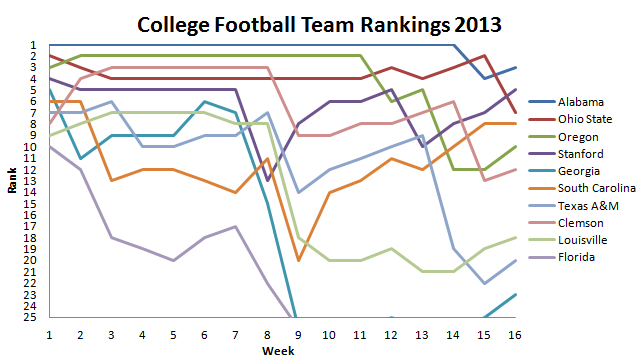
I was curious how college football rankings change over the course of a single season, so naturally I scraped a bunch of data from ESPN and made a graph:  Specifically, I looked at the AP Top 25 and only plotted the teams that started the year in the top 10 spots (because looking at a plot of all 25 is a mess).  Here are some observations: 
  1. Half of the top 10 teams at the beginning of the year are members of the SEC.  That sounds about right.
  2. Half of the teams that started in the top 10 finished in the top 10.  Of the remaining five teams, four finished in the top 25.  What happened to you, Florida?
  3. Alabama and Oregon were ranked in the top two spots for 10 out of 16 weeks.  Neither team is playing for the national championship.  That goes to show you consistency doesn't matter.  Winning at the end matters.
  4. The two teams that are playing in the upcoming national championship game and who are ranked numbers one and two aren't included on the plot.  Florida State started the year at number 11, and Auburn didn't make the top 25 until week 8.  That's a little ridiculous.
In conclusion, I quite enjoy college football. #sports

NFL team name categories (7)
I noticed recently that NFL team names can be grouped into one of five categories: 
  1. Birds:  Cardinals, Eagles, Falcons, Ravens, Seahawks
  2. Cats:  Bengals, Jaguars, Lions, Panthers
  3. Large Mammals:  Bears, Broncos, Colts, Dolphins, Rams
  4. People Group, Historical Figure, or Occupation:  49ers, Bills, Buccaneers, Chargers, Chiefs, Cowboys, Packers, Patriots, Raiders, Redskins, Saints, Steelers, Titans, Vikings
  5. Other:  Browns, Giants, Jets, Texans
Yes, I realize it's a stretch to call a dolphin a large mammal, but it's technically accurate.  And a Charger is someone who charges into battle.  Stupidest team name:  Browns, named after one-time owner Paul Brown.  That's the best they could come up with? #sports

Tony Romo chokes (1)
This image of Tony Romo from the 2006-7 playoffs still makes me laugh:  On the one hand, I feel a little bad for the guy, since this image has been burned into the collective conscience of the American football fan.  On the other hand, it's always good to see the Cowboys lose. #sports

Bowl schedule
I think it's stupid that the current schedule of college football bowl games consists of a bunch of insignificant, poorly-named, ill-timed matchups that take place randomly over the course of 7-10 days, often over a month after the end of the regular season.  When I'm elected Supreme Commander of All Things, here's how I would change that: 
  • First of all, no more PAC-10 changing its name to PAC-12, or a BIG-10 with 12 teams.  Stick to letters.  BIG-10 and BIG-12 get to fight out the details.
  • Season ends with conference championships.
  • Conference champions compete in bowl games.
  • The National Championship Game cannot contain two teams from the same conference.
  • Bowl games take place no more than two weeks after the end of the regular season.  All in one day.  The end.
Everybody who has ever had an opinion about college football agrees that the current system is stupid.  Yet the system remains. #sports

Polamalu quote
I missed the game, and I dislike the Steelers, but I like what Troy Polamalu said about this past weekend's game: 
When asked about the play after the game, Polamalu said, "Whatever is going to get me in trouble, I'm saying the opposite."
I like his style. #sports