|
Bible errors
|
Apr 13, 2005
|
|
I'm really not a big fan of errors in books. I'm so painstakingly anal retentive that whenever I read anything, whether it's a book or a magazine or a presentation at work, I always find mistakes. Always. It would be good if my job was as an editor, which I actually do occasionally at work. So it really makes me mad when I find errors in the most important book on earth, the book that my whole life is based on: the Bible. I've never found an error in the actual physical Bible (the one with a cover and with pages and stuff). But I've found errors in two other Bibles: the online Bible and the Bible on CD. The errors I've found are tiny; they don't change any meaning or hurt the reader in any way. The thing I don't like is that the Bible is meant to be a reliable book. The ancient Jewish scribes used to make copies of it, and they didn't take it lightly. That's why there have been so many manuscripts found that are all identical: no mistakes were allowed. So that's what really gets me. Not only this, but when I point out these mistakes to the people who run/own these sites/products, they don't even respond. It kills me. Here's an example: Galatians 5:23 says: "gentleness and selfcontrol. Against such things there is no law." Any idiot can look at that and realize that "selfcontrol" is spelled wrong: it needs a hyphen. Also, any idiot can type that into Microsoft Word and the automatic spell checker will tell you it's wrong. So when I filled out the "Typographical Errors" form on their website on March 1, I was hoping they would quickly and easily fix the problem. But now that it's quite a while later and they still haven't fixed it or responded to me, I doubt they'll ever do anything. That makes me mad. Now there's Zondervan, who makes the NIV Audio Bible Voice Only CD. It's a great product. I listen to it all the time now because I can't stand the radio. But the problem is that I found an error in Titus 3:5, which is supposed to say, "he saved us, not because of righteous things we had done, but because of his mercy. He saved us through the washing of rebirth and renewal by the Holy Spirit." On the CD, it says "washings" instead of "washing." That might not sound like a big deal, and it's really not. But think about it: the only reason I noticed this error was because I happen to have this verse memorized. What about the tens of thousands of other verses in the Bible that I don't have memorized? This is exactly what I wrote to Zondervan on 3 separate occasions: February 3, March 10, and today. I would just like a response from them; something to at least acknowledge that they received my email, and maybe that they'll look into it. #religion
|
|
Faith and deeds
|
Apr 8, 2005
|
|
I was talking to a very devout Catholic the other day about the differences between Catholicism and "Evangelical Protestantism," also known as Christianity. He was saying that he (and the church) disagrees with the idea of salvation solely by faith because a person can claim to be saved and even accept Christ as savior, but the person may then continue to lead their previous way of life, thereby showing no commitment or change. I agree with this to a certain point. If a person is truely saved, the Holy Spirit will work through them and they will eventually become more like Jesus Christ. But the problem is this: how many good deeds must a person do to prove that their salvation is sincere? The Catholic would answer that a person doesn't need to prove their salvation through deeds, but that the deeds would naturally follow if the person was sincere. So I ask this: would the Catholic say that a person who accepts Christ as their personal savior is not actually saved until their faith is shown through their deeds? If this is the case, then it sounds to me like a person isn't saved until they do something to prove it (or verify it), which is a deed. In other words, faith and deeds save a person. The Catholic person I talked to was very careful about his wording; he would find a way to contradict what I've just said. So this brings up another point: isn't a person acting out of faith by accepting Christ as their personal savior? Does this not count as an action performed out of faith? This would satisfy the requirements for the Catholic (faith accompanied by a deed) and the Christian (faith alone). #religion
|
|
Pride
|
Apr 4, 2005
|
Pride is the root of all sin. It's at the bottom of everything we do wrong. It was there at the beginning, when Eve said to the serpent, "Yeah you're right. God and Adam don't know what they're talking about. This fruit won't kill me." It was there when Lucifer wanted to have as much power as God. This is why he was cast out of heaven. It's in us when we say "Why does bad stuff happen to good people? Why is there suffering in the world? Why does evil exist?" because we're saying we know better than God. It's there with rape/murder/theft/assault, because it's saying, "I'm better than this person." It's there with sex before marriage, because it's saying, "I know God doesn't want me to do this, but God just doesn't understand the situation I'm in."
I think you can break everything down to this one thing: pride. More to come later. #religion
|
|
Sickness
|
Apr 1, 2005
|
|
Similar to my beliefs about death, I think that sickness and disease exist to draw us closer to God. Pretend for a moment that you're God: you create the heavens and the earth and put some people on the earth. In a very short time, they forget about you because they're distracted by what's happening on their planet. So you make them realize that they won't be there forever by letting some plants and animals die. But they don't understand; they just cook the dead animals and eat them. So you make some people die, hoping that other people will realize that they too will die someday. But all this does is cause fear and anger towards you, their creator. You pull out some of your hair and take a deep breath. So you figure, "I know: I'll make them sick so that they're close to death, but they don't actually die. Then they'll realize that they may die at some point, but it won't make anybody scared or mad." But then some dude comes along and figures out how to heal the sickness you gave to your creation. So you have to think of something else that they can't fix. But each time you give them a sickness, they figure out how to cure it; they're very resourceful little things. So amidst all this stuff, your sole purpose was to help your creatures remember you. Now stop pretending you're God because that's not good. #religion
|
|
Dividers
|
Mar 31, 2005
|
Why is that in every group of Christians, whether it's a Bible study or a fellowship or some other gathering, there's always that one person who insists on being a divider? They always feel the need to play devil's advocate and bring up their controversial opinions or conspiracy theories. There was MB in my college fellowship, who, when asked why he was so argumentative, argued that he wasn't argumentative. Now there's KN in the Bible study at work, who always says stuff about priests getting paid a lot of money and how the Bible is unreliable and how Catholicism is the only way. My question is this: if these people don't agree with anything being said, why do they even show up? What's their purpose? Why do they insist on disturbing the group and causing division and doubt? Do they want to convince people of the erroneous things they believe? Or do they just enjoy being a distraction?
On a positive note, I'm sure God has a purpose for these people. And I'm sure they're serving some sort of purpose in our lives. I just have trouble imagining what it is. #religion
|
|
Luck (1)
|
Mar 28, 2005
|
|
I don't believe in using words like luck, coincidence, and ironic. It implies that everything is left to chance, which completely leaves God out of the equation. As one of my roommates once said, "God just isn't part of the equation right now." But seriously, to tell someone "Good luck!" is like saying, "Hey, see what happens out there and where chance takes you because there's no rhyme or reason in any of this. The universe is composed of complete disorder, and to have any expectations would be futile. Just try to walk in conformance to 'how things are' and accept things as they come." This isn't cool. I slipped up and told somebody, "Good luck with the Marines" on Friday night. I felt like such an idiot. I haven't used the word luck in quite a while. It's no longer a normal part of my vocabulary. In place of that I use things like "have fun with that" or "best wishes." At least these phrases mean something. Also, in place of the words coincidence and ironic is the word "providential," which means "Happening as if through divine intervention." Now that's what I'm talking about. #religion
|
|
Bible times
|
Mar 25, 2005
|
I'm thinking that things were kinda different in Bible times. I think Christianity would be a lot more believable (for people who don't believe) if we were still living in Bible times. All the people of the nations surrounding Israel acted in a similar way: they sacrificed burnt offerings and peace offerings to gods. To us, this means nothing because we don't know what sacrificing stuff means, and we usually associate it with cults. But to the people in Bible times, it was fresh in their minds and made all the sense in the world. So the idea of sin also made sense to them. If you sinned, you needed to sacrifice to God. There needed to be blood shed for the forgiveness of sins (Leviticus 17:11). Similar to the idea of sin, the idea of a savior would also have made sense: a person/thing to pay the price for everybody's sin. This would be appealing.
There was more to this thought. I just can't remember it right now. It keeps coming to my mind, and it makes a lot more sense before I try to verbalize it. #religion
|
|
Death
|
Mar 25, 2005
|
|
This may sound kind of crazy, but I have an idea about death: I think the purpose of death is to bring people to God. Think about it: when people die, it causes us grief because it causes a void, we're unsure of what happens after death, and it scares us to think of our own death. But with God, we can take comfort in God's peace, because nothing else will fill that void. We can have confidence that those who know him will be with him when they die. And we can be sure that death is nothing to fear: it's when we meet God face to face. #religion
|
|
Christianity or science
|
Mar 23, 2005
|
|
I was thinking this morning (amazing, isn't it?), and I came upon a thought that I've had before: sometimes believing in science instead of Christianity takes more faith than Christianity. For example, are we to believe what science tells us: that complex, living, eating, breathing human beings evolved from nothing? Just take a look at us; think about how everything just works without even doing anything about it. Right now, my heart is pumping blood to every part of my body, carrying oxygen so that the muscles in my lungs can expand and contract. There are tiny little electrical impulses moving all around my brain, on the magnitude of 100-200 pulses per second. And this is just breathing and thinking. What about all the other millions of things we do on a continual basis? You think this came from nothing? From one-celled organisms that developed out of nothing into something? That takes a lot of faith to believe. For me, I'll continue to believe that I was created by a supreme being, God. It just makes more sense. #religion
|
|
Jesus fish
|
Mar 21, 2005
|
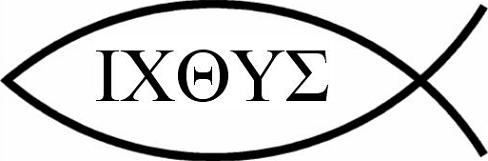
Ιησους Χριστος Θεου Υίος Σοτηρ
Iesous Christos Theou Uios Soter
Jesus Christ, God's Son, Savior
#religion
|
|