Small differences
Recently, someone asked about the difference between a sound (such as Puget Sound) and a bay (such as San Fransisco Bay).  Here's what Wikipedia says: 
A bay is an area of water bordered by land on three sides. 
A bight is a large (and often only slightly receding) bay. 
A gulf is a part of a lake or ocean that extends so that it is surrounded by land on three sides. 
A fjord is a narrow inlet of the sea between cliffs or steep slopes. 
A sound is a large sea or ocean inlet larger than a bay, deeper than a bight, wider than a fjord, or it may identify a narrow sea or ocean channel between two bodies of land. 
A bay generally occupies an area wider than a fjord but smaller than a sound or gulf, either of which may include one or more bays. 
Twice in the past 6 months, I've learned and forgotten the difference between a state and a commonwealth.  Here's what Wikipedia says: 
A state is one of the 50 entities of the United States. 
A commonwealth is an area/region that has a "government based on the common consent of the people" as opposed to one legitimized through their earlier Royal Colony status that was derived from the King of England.  This designation, which has no constitutional impact, applies to Kentucky, Massachusetts, Pennsylvania, and Virginia. 
A commonwealth (insular area) is an organized territory or colony that has established with the Federal Government a more highly developed relationship, usually embodied in a written mutual agreement.  This designation applies to the Northern Mariana Islands and Puerto Rico. 
I continually confuse the following two words, though they have completely different (opposite) meanings: 
Condemn:  To express strong disapproval of. 
Condone:  To overlook, forgive, or disregard (an offense) without protest or censure. 
#language

Bi
[Uh oh ... where's he going with this?]

I've had enough.  From now on, everyone must adapt the following language changes: 
  1. Biweekly means twice a week.
  2. Bimonthly means twice a month.  (Who would use bimonthly to mean every other month?  I mean, honestly, who?!)
  3. Biyearly means twice a year.  Semiannually is also acceptable.
Forget everything else you know about these words.  Do as I say.  I've finally settled the "usage problem" with the prefix bi-. #language

Manamana
I was in a meeting a few weeks ago, and there was a squirrelly guy with a mustache who kept using the word "phenomenon" incorrectly and increasing the number and length of endings on it.  At first, he said something about "studying the phenomenon that was happening".  After a little while, he said something about "characterizing the phenomenology of the project".  A little while after that, he said something about the project's "phenomenologically advanced technology".  By the end of the meeting, he was just adding anything he could think of to the end of the word:  Phenomenologicallistically, phenomenologicalism, phenomenologicalisticide.  The guy was just going nuts. #language

Geek quote
Geek quote of the day: 
"...the excrement encountered the rotary cooling device."
Ha! #language

Grammar my way
I learned how to write in junior high and high school.  Years of repetitive English classes drilled rules and patterns into my head.  But there were a few things I was never comfortable with, so I break some major rules pretty often: 

1.  Prepositions ending sentences.  "Prepositions:  What are they good for?" is a perfect example of why I don't like that rule.  I speak this way in normal, everyday conversation, so prepositions will appear at the ends of sentences in my writing. 

2.  Commas separating groups of things.  There should be a comma before the "and" if you have a first thing, a second thing, and a third thing.  The rules say it can be done either way; I think it's either my way or the wrong way. 

3.  Punctuation within quotations.  Did I say, "Shut up?"  Or did I say, "Shut up"?  I think I said the latter, and even though it breaks major punctuation/grammar rules, that's the way I do it.  I also might use punctuation in the quotation and outside as well:  I used to say, "Shut up jerks!". #language

Two spaces (5)
Back in the early days of high school or junior high, I learned to put two spaces after the period at the end a sentence when typing.  I've been doing this ever since.  I've noticed that I'm the only person on earth who does this.  I figured everyone else was wrong, as is usually the case.  But it turns out that it's an ongoing debate.  Basically, the old way of doing things was to put two spaces after the period.  This practice began with typewriters and fixed-width fonts (like Courier), where every letter takes up the same amount of horizontal space on the page.  It was straining on the eyes to read long documents where sentences weren't separated by more than one space, so the extra space was added to make reading easier.  This "old school" approach was handed down and continued by typing teachers, most of whom are old ladies.  But since the advent of proportionally-spaced fonts (like Times New Roman and pretty much everything else), the extra spaces seemed unnecessary to most people.  Also, the introduction of the interweb and HTML made the double-space even more obsolete because HTML only shows one space, whether you put two or seventeen.  But no matter what the current standard is or what's commonly accepted, I'm sticking with my way of doing things because it's arguably the best way of doing things. 

More info here, here, and here. #language

Proven
"Proven" is actually a real word.  It's the past tense of the word "prove".  For some reason, Mr. Google Toolbar doesn't think it is.  Every time I spell check one of my posts, it reminds me of this.  But Mr. Free Dictionary says it's a word.  It sounds right in my head, so I'm gonna continue using it. #language

Inflection
I work with a guy who's been doing a really weird thing lately.  He calls a lot of people during the day and leaves a lot of messages.  At the end of his messages, he says something like, "Call me back when you get a chance.  Thanks.  Bye."  When written out, this is normal.  But the way he says it is really weird:  His inflection on "bye" goes down to up, instead of up to down.  Try it.  It's totally unnatural. #language

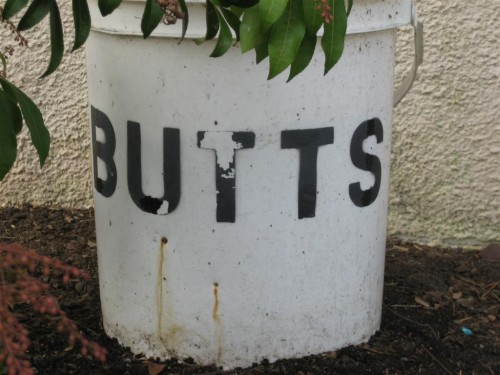
Butts
From a fortune cookie:  "The only limits to the possibilities in your life tomorrow are the buts you use today."  How can I be expected to take that seriously?  The picture below is from Wendy's mom's retirement village recreation hall. 

#language

Airport sign (5)
My sister Stacy found this sign in the Seattle-Tacoma International Airport.  "Elevators to Teminal".  Not to be racist, but that's what you get for overseas outsourcing. 

#language