|
Small changes over time
|
Dec 15, 2010
|
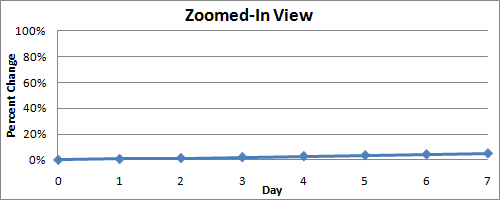
I believe that small changes over time can have a big impact in the long run, either in a positive or negative way. I'll use a graph to illustrate my point:

Let's say you start at (0,0) and make a minuscule change over the course of a day. After that first day, you're a tiny fraction off from your original location. Even after a week, you're still only a few percentage points off, which is hardly noticeable. Now let's zoom out a bit and look at the bigger picture:
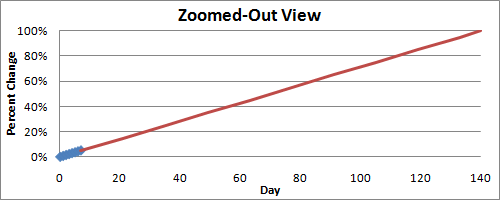
After a considerable amount of time (140 days in this case), you're a considerable percentage off from your original location (100% off in this case). The numbers are fairly meaningless, but the concept is valid: We tend to look at different changes from different perspectives, leading us to behave in some pretty irrational ways.
In a positive sense, for long-term changes, we often look at the zoomed-out view and only notice how far we are from completion. Some examples are things like getting a degree, buying a house, and losing weight. If instead we focused on the zoomed-in view and simply made incremental changes over time, we'd get there eventually.
In a negative sense, for long-term stability, we often look at the zoomed-in view and only notice how little we've drifted from one day to the next. Some examples are things like relationships, morality, and spirituality. If instead we focused on the zoomed-out view and realized how far we've drifted from our original position, we'd realize how drastically small changes add up over time. #psychology
|
|
Communicating excitement
|
Dec 3, 2010
|
|
I've noticed that the excitement one person has about an idea doesn't always spread to another person. The idea can be good, and it can be communicated well, but if the other person is on a different page, or if it's just not the right setting, the excitement evaporates. This happens a lot at Bible studies, when I think I have something good to add, and I can even gather my thoughts and convert them into speech pretty well, and I expect everyone to totally agree with me and for the issue to be settled, but then it doesn't happen. Other people talk, or the original issue gets rehashed, or both. Afterward, I'll go over my thoughts in my head, and reaffirm my good idea and the reason I'm excited about it. But just because it's exciting for me, doesn't mean it has to be exciting for everyone else. To each his own, I suppose. #psychology
|
|
Funded ignorance
|
Nov 23, 2010
|
Upton Sinclair: "It is difficult to get a man to understand something, when his salary depends upon his not understanding it!" From I, candidate for governor: and how I got licked. #psychology
|
|
What I can control
|
Nov 12, 2010
|
I'm a control freak, which takes the following forms: - I'll drive, because I don't trust anyone else with my safety.
- I'll rake the leaves and shovel the driveway, instead of paying some teenagers to do it, because I do a better job than they would.
- I'll design my own website, because I don't like the way anybody else does it.
It was only fairly recently that I realized I was a control freak and admitted it could possibly be a negative thing. Control-freakery is sometimes good because it's often accompanied by perfectionism, which means certain tasks like cleaning and organizing get done, and get done well. But it's bad in pretty much every other aspect, as evidenced by the primary side effect of being a control freak: Getting angry about everything.
The thing is, most things are out of my control. Things like election results, cable TV outages, and people who leave their blinker on after they make a turn, are all things that are outside of my control, and since I can't control them, it makes me angry. What's worse is that a lot of times there's an illusion of control. Like with elections, I can exercise my right to vote, which makes me feel like I'm part of the process, but in the end the final decision is not in my hands. It's similar with people who can't drive: Maybe if I can just tell them they forgot to turn off their high beams, it'll make everything alright. But in the end, that person can still decide to high-beam me, and that's not something I can control.
The more I think about this topic, the more things I add to the list of things I can't control. I thought I had it pretty well summarized by saying the only thing I can control is me. But then there's the issue of my health: Even if I eat well and exercise, there's still a chance I'll get sick or develop a disease. So my own health is outside of my control. But at least I can control my actions, right? Wrong, if I happen to have muscle spasms or a seizure. Surely my speech is under my control. Nope, not if I have Tourette's. My thoughts? Sometimes. But sometimes not.
So in the end, I can pretty much control nothing. #psychology
|
|
Different values (1)
|
Oct 29, 2010
|
Sometimes I learn things that blow my mind. Such was the case a while ago when Wendy told me that not everyone thinks rationally. How an irrationally-thinking person doesn't irrationally decide to jump off a building to attempt human flight or go on a killing spree just for fun, I may never understand. Rational thought generally prohibits these actions; irrational thought, I would presume, might make them sound attractive.
As we were waiting at the gas pump the other day, I watched a guy in a little car pull into a parking space where he had plenty of room on either side and he had all the time in the world to do it right, but he totally pulled in crooked and over one of the lines. I laughed at how much of an idiot he was, but Wendy simply said, "Not everyone values parking straight." That almost made my head pop, though not because of anger. It's because I'd never thought of the fact that different people have different values, even with seemingly universal things like parking straight. Maybe some people don't value getting all their waste products in the toilet, hence why public bathrooms are so disgusting. Maybe some people don't value not smelling bad, which is why they eat onions and garlic and don't wear deodorant. Maybe there's a fairly simple reason for a lot of the things that piss me off, and aside from the obvious "you can't control what other people do, so stop trying," it's largely because not everyone is exactly like me. This is probably something I should've learned in kindergarten. #psychology
|
|
Belief and behavior (3)
|
Jul 30, 2010
|
I once heard someone say, "We communicate our values." Another person put it this way: "We act out our beliefs." Craig Groeschel, pastor of LifeChurch.tv, told this story in one of his sermons: What you believe determines how you behave ... For example, one time, when my oldest son Sam came running in, throwing up into his hands ... *blechghchgh* and he said, "Daddy, Bookie is eating his poop!" So I ran past Sam who was throwing up in his hands and ran into the room where there was little Bookie, my second son, with dark stuff all over him. And I threw up, not in my hands. It was like, violent, vomiting. It went well beyond my hands. It went everywhere. So Sam's in throw-up, I'm in throw-up, and so we did the only thing we could do, which was call for Mom ... She came busting in, by all the throw-up, and there was Bookie with the dark stuff. And she just went up to him and wiped off the smudged Oreo cookie which was on his face. Wasn't poop; it was Oreo cookie. But we believed it was poop, and so it affected us as if it were poop. That's probably the best sermon I've ever heard. And he makes an excellent point. #psychology
|
|
Induced guilt
|
Jun 11, 2010
|
|
Whenever I'm being watched for criminal activities, like for shoplifting at a store or terrorism at an airport, I tend to get nervous and try to look innocent, which has the effect of making me look like I'm trying to look innocent, which makes me look guilty, which I'm not. For example, I tend to walk around with my hands in my pockets, but when I'm at a store and take something off the shelf to look at it but end up putting it back on the shelf, I realize I can't put my hands back in my pockets because it'll look like I'm stealing something, so I'll intentionally walk away with my hands not in my pockets, which makes me conscious of the angle and rate at which I swing my arms, which probably makes it look like the first time I've ever attempted to walk in my life, which makes me look guilty, which I'm not. Another example is when I'm at an airport and I'm waiting in line (which is often) and I'll casually look around and accidentally find the location of every security camera that's pointing at me, including the ones on the ceiling, which makes me picture the people in the control room looking at the many different TV screens with views of this white male in his late 30s (hey, I'm 28!) who's nervously noting the locations of any and all security cameras, which makes me look guilty, which I'm not. I swear. #psychology
|
|
Say ouch (2)
|
Jun 7, 2010
|
|
A woman in Wisconsin recently got caught shooting random people with a blow gun and a slingshot simply because she liked hearing people say ouch. To me, this sounds like misplaced talent. Perhaps she could be more gainfully employed as a professional torturer. Or one of those people who shoots wild animals with blow darts so they can be moved to a different location or have a snare removed from their leg. Most people see failure; I see an opportunity. #psychology
|
|
Talk on wake
|
May 25, 2010
|
|
Certain people (including Wendy) have the amazing ability of being able to talk the second they wake. I call this an amazing ability because I don't have it. It takes me an incredibly long time to wake up, and probably the last thing on my list of things to do when I wake up, after shower-dress-coffee, is talk. This could be because talking isn't my strong point, but it could also be because my brain needs warm-up time. The wheels start spinning very slowly, and even if I can form thoughts, I can't quite put those thoughts into words. People who can talk upon waking are like on-off switches. I'm more like a computer that needs to boot up. #psychology
|
|
Overt stoner
|
May 25, 2010
|
|
I work with a guy who thinks he's a stoner. His most common words are "dude," "bro," and "like," all stated in a slow, somewhat raspy tone. He likes to talk about fishing, and drinking, and many other fascinating things. The thing is, I have no problem with people who smoke pot. In fact, I think the stuff should be legal. But I do have a problem with intelligent people who work in a professional environment pretending they're present-day stoners. Maybe you were a stoner in high school or college or in post-college unemployment, but now it's time to grow up. And even if you still smoke pot, at least don't act like a 17-year-old idiot who's, like, totally bummed about, like, everything, man. Bro. #psychology
|
|