License plate covers
I can't for the life of me figure out how those shaded license plate covers -- which are marketed as a way to protect your poor fragile license plate from the harsh elements, but are clearly meant to obscure your license plate from police and speeding/red light cameras -- are even remotely legal.  I'm guessing they're either (a) not as effective as people think, i.e. a cop will get your license plate number when and if he/she actually pulls you over, or (b) completely useless because camera lenses are polarized or something like that.

QR code disappointment
I always get a little excited when a poster or a menu or something tells me to scan a QR code with my phone.  I always think something fun and exciting will happen, like there's some hidden information I'll be learning by using my high tech pocket device to analyze a mysterious symbol.  And then it's just a link to a website of the place I'm currently at.

Website redesign with Python
Oh hi there, I just completely redesigned my website from the ground up.  When I originally wrote the backend for this website over a decade ago, I pretty much just cobbled together some things I found on the internet and hastily added functionality as I saw fit.  It was pretty messy code with almost no comments, and there was markup mixed in with logic.  Miraculously, this served my needs for quite a number of years with really no issues.  But during that time, if I wanted to add functionality, it was a bit messy.  And the same goes for visual design.  If I want to change how things looked, I had to wade through a bunch of code to find the relevant bits of HTML markup.  Also, all the code was written in an old version of PHP which my web host has been charging me extra to support.  So I decided to embark on a little project. 

I rewrote the entire backend in Python, from scratch.  I chose this language for a couple reasons, the main one being that I've been using it at work and I like the idea of dual-purpose things.  And I said "from scratch" because this wasn't a simple "translate from one programming language to another" thing.  The two languages operate very differently, and I've gotten better at writing code, so I wanted this to be written well.  Modules instead of single files, markup separate from code, testable functions and documentation throughout.  The other reason I wrote it from scratch was because my web host (and a few others I tried) had major problems installing anything, including frameworks like Django and Flask

This led to my next major change:  Switching web hosts.  My longstanding prior web host used a fairly old version of Python.  Basic functions that are included in all modern versions of Python were nonexistent.  So I looked around and experimented with a few until I settled on DreamHost, which I originally migrated away from after an unfortunate billing incident.  I also switched to them as my domain registrar, which took a ridiculous amount of time and headache to complete. 

The final major change is that I adopted the Bootstrap framework to hopefully make design and layout easier and more accessible.  I've always "designed" my website my hand, which isn't saying much because I tend to stick with black text on a white background.  But I've always had trouble with sizing and spacing on different screen sizes, so hopefully this will alleviate that. 

All in all, this was a year-plus effort (not full time) and an interesting excursion for me.  I'm still tinkering with things, so there is some missing functionality and broken links, and the layout on mobile looks atrocious.  It's a work in progress. #technology

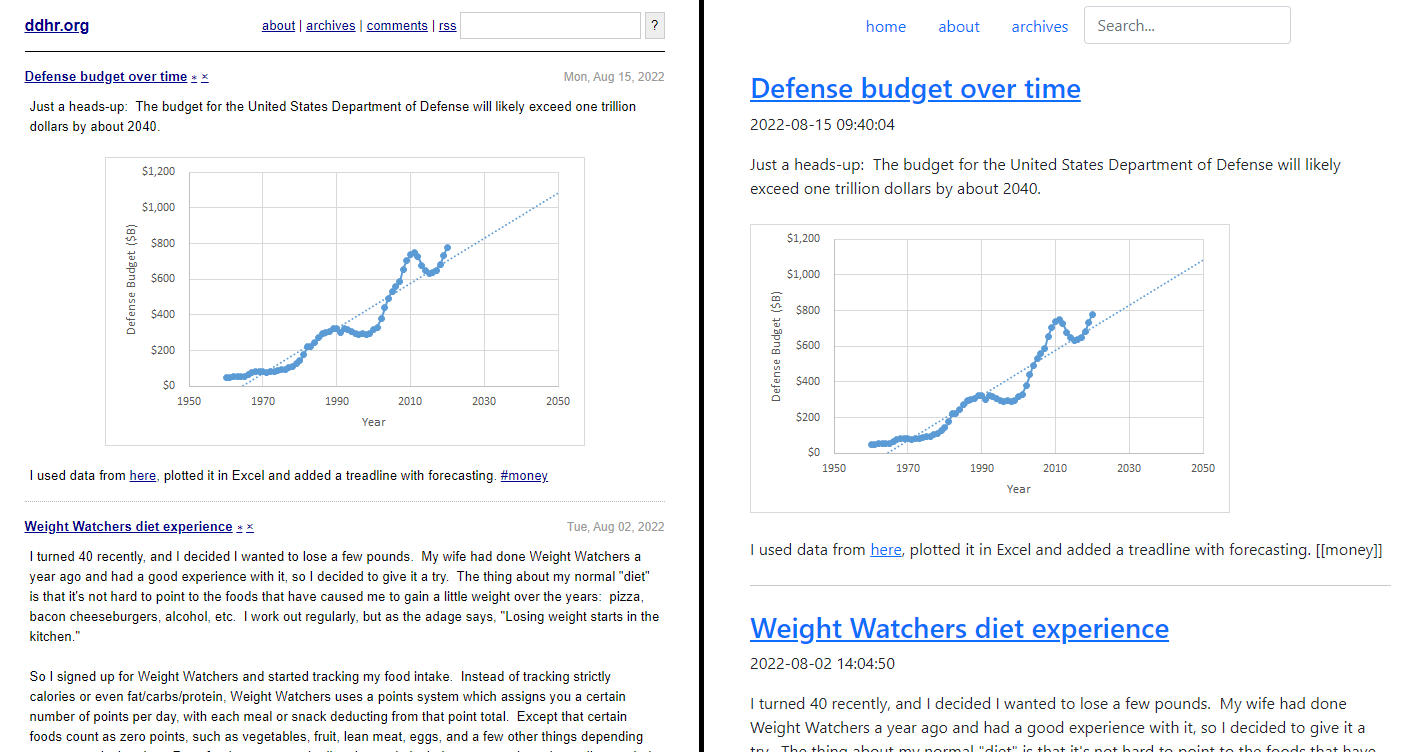
Defense budget over time
Just a heads-up:  The budget for the United States Department of Defense will likely exceed one trillion dollars by about 2040.  I used data from here, plotted it in Excel and added a treadline with forecasting. #money

Weight Watchers diet experience
I turned 40 recently, and I decided I wanted to lose a few pounds.  My wife had done Weight Watchers a year ago and had a good experience with it, so I decided to give it a try.  The thing about my normal "diet" is that it's not hard to point to the foods that have caused me to gain a little weight over the years:  pizza, bacon cheeseburgers, alcohol, etc.  I work out regularly, but as the adage says, "Losing weight starts in the kitchen." 

So I signed up for Weight Watchers and started tracking my food intake.  Instead of tracking strictly calories or even fat/carbs/protein, Weight Watchers uses a points system which assigns you a certain number of points per day, with each meal or snack deducting from that point total.  Except that certain foods count as zero points, such as vegetables, fruit, lean meat, eggs, and a few other things depending on your particular plan.  Fatty foods, pretty much all carbs, and alcohol count as points, depending on their type and amount.  What this means is that you're incentivized to eat a bunch of zero-point foods while carefully choosing where you spend your points budget.  For example, a whole grain wrap for a chicken burrito costs about as much as a beer, so if I want to eat well, I might have to skip the beer. 

This was not a starvation diet.  At no point was I ever really hungry.  There were times when I was unsatisfied, but I was able to find some foods like apples and carrots that took away my cravings. 

The points system sounds like it won't work because you're not directly tracking calories, but it sort of works like magic.  It's a little annoying to have to trust a system whose internals you don't fully understand, but at the same time it's mentally easier to understand the cost of a 4-point beer in a 20-point program versus a 130-calorie beer in a 2200-calorie diet.  The math is just simpler. 

Long story short, I lost two pounds per week for about two months straight, and I'm down 18 lbs and counting. #lifestyle

Active mind wandering
I've been doing a lot of hiking recently, and one thing I like to do is let my mind wander.  Usually when I'm walking or hiking or doing some activity that doesn't require brain power, I listen to music or podcasts, or I think about what I need to get done, or how to solve a problem I've been working on.  But lately I've been going out, leaving my electronics at home or in the car, and just letting my brain do what it wants.  It's kind of a cool sensation, almost like observing my brain in third person.  I can see an idea appear, and I just let my squishy computer go with it.  There's no objective or end state or anything I need to remember or write down.  It's just low-level mental processing, turning the gears and cranks, for no other reason than it's enjoyable. #psychology

Quitting caffeine
I quit caffeine as of a few weeks ago.  I had been drinking up to 8 cups of coffee per day (only 2 scoops of grounds though) for the past few years, and I had developed a slight sweating problem.  I'm not completely sure the two things were related, but I had been thinking about giving up caffeine anyway.  I don't like the idea of being dependent on something.  What if I'm somewhere where I can't get a fix?  And really that's what caffeine has become for me.  It's long since stopped being a morning pick-me-up or anything like that.  It's a substance, that if I don't ingest on a daily basis, I'll get a miserable headache and feel like garbage. 

I'm really not sure what to believe about the health benefits of caffeine.  I've heard it can be good.  I've heard it can be bad.  My thought is that our ancestors existed just fine without it.  Plus it's certainly not an essential vitamin or mineral or anything like that.  There's nothing in coffee or tea or any caffeinated beverage that's necessary for our bodies to function, that we can't get from eating regular food.  We can live without caffeine. 

So anyway, I slowly decreased my coffee volume consumption while also slowly decreasing the strength of the coffee itself.  The last couple weeks were a cup or two with more than half decaff grounds.  AND YET, when I quit completely I still had a stupid headache and felt crappy. 

Now that I'm caffeine-free, I'd like to say I'm sleeping better and feel great.  But honestly I feel exactly the same as I always did, albeit a little less sweaty. #food

Hybrid work
We've entered the era of hybrid work, which is a combination of on-site work and remote work, and I gotta say, it's literally the worst of both worlds.  The benefits of on-site work are that you see people face-to-face and run into people in the hallway for impromptu chats.  The benefits of remote work are that you can concentrate distraction-free while not wearing pants.  Hybrid work, as it's currently implemented, is left to the worker to decide how to manage their on-site and remote days.  So some people choose to be in the office Monday and Wednesday; other people choose Tuesday and Thursday, etc.  What this means is that on any given day you're in the office, you have absolutely no guarantee that the people you want to see will be there.  Which means that not only is your presence completely wasted, you're also working in a distracting office and you had to put on pants to do so.  And to get in contact with people, you have to call or message them anyway, which is the exact same thing you would've done if you weren't in the office. #business

Older coworkers
I was talking to some coworkers and we were all noticing how certain people we work with have a hard time adopting new technology.  Here we are a few years into a pandemic-fueled remote work world, and some people are still learning how to share their screen in Microsoft Teams.  One coworker said it's because our generation (born in the 1980s) were the first generation with internet in our homes while we were in high school.  We're used to adapting to the ever-changing landscape of technology.  We remember a time before the internet, before smartphones, before social networks.  And as these new things came about, we (sometimes grudgingly) adopted them and incorporated them into our daily lives.  People who are even a few years older seem to have been almost left behind in the pre-digital age.  They write things on paper; they cold-call people without messaging them first; they have trouble with copying and pasting and emails.  It's weird how there's almost a generational gap in technological proficiency, and the age difference is sometimes less than 10 years.

Trunk lock issue
My current car's trunk has two methods of entry:  An electronic switch near the steering wheel, and a keyed lock on the trunk door.  Most normal cars also have a latch on the back seat, but mine doesn't. 

A few months ago, my battery died due to the interior light being left on overnight.  What happens when a car has a dead battery?  The electronic trunk release button doesn't work.  What happens when you live in a cold climate with road salt and a seldom used keyed lock?  It seizes.  So in the middle of winter, with a dead battery, I was unable to get the jumper cables from my trunk because the idiots who designed my car couldn't envision a scenario where this series of events could happen. 

It wasn't a huge deal because I borrowed my wife's car to go to a store to buy jumper cables, which she needed anyway.  But if someone, perhaps a small child, got stuck in my trunk, I have a hard time imagining the success rate of convincing said child to follow my instructions in locating and operating the glow-in-the-dark emergency trunk release lever (which thankfully my car does have).