|
Music vs. running speed
|
Aug 4, 2010
|
I'm a nerd, so I went running today with an iPod and a GPS device, and I extracted and correlated the data from each device to show which song was playing at different points along my run and how fast I was running at each of those points, and I put that data into Excel and plotted it:
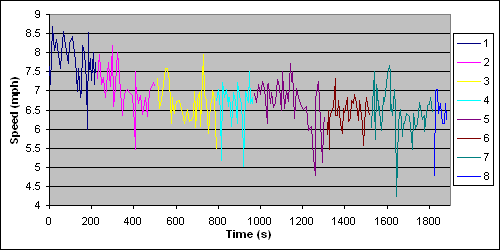
See? That's nerdy. What I was trying to determine was if certain music made me run faster or not. The specific songs don't particularly matter, but each was selected (by me) for the purpose of working out, which means they were of the rock variety, and generally loud and fast. In general, my speed decreased throughout the run, which makes sense. And those big spikes in the data are just GPS noise; nothing significant. But what stands out to me is the following: - I started out pretty quick, both because I had lots of energy and also because that particular song matched up exactly with my pace. The internet says it's 162 beats per minute, which equates to a little less than three steps per second.
- Right around the 600-second mark was when I experienced my first cramp, and then right around the 1200-second mark is when I got the second one. Both cramps brought about a decrease in speed, and then a subsequent increase after they passed.
- That song right about in the middle of my run, which corresponds to track number 5, seemed to have a small but noticeable effect on my speed. That particular song has been in my music collection for a good decade, and it still pumps me up.
In conclusion, music is like a drug to me, and it makes me do things I otherwise normally wouldn't or couldn't do. Here's to running, and music, and nerdiness! #sports
|
|
Isotopes of baseball
|
Aug 2, 2010
|
|
The Albuquerque Isotopes are a minor league baseball team based in Albuquerque, New Mexico. I verified this with my own eyes on a recent visit. This is notable because (a) nearby Los Alamos National Laboratory was and is heavily involved with nuclear weapons research (isotope = nuclear thing), and (b) the team name was inspired by an episode of the Simpsons (the Simpsons' home town of Springfield has a nuclear power plant). Yay science-TV-real-life! #sports
|
|
Olympics observations (2)
|
Feb 24, 2010
|
Here are some of my observations from watching the Winter Olympics: - It's weird when non-native citizens or at least non-resident citizens represent a certain country. There was an American figure skater who represented the nation of Georgia, and there was at least one skier who lived in America but was skiing for Canada. I'm assuming the Olympic committee has some sort of application process where you need to show them a utility bill or something like that to verify your citizenship. But otherwise, it just seems like a good way for an Olympic hopeful to get to the games, when perhaps it might be difficult to do so, i.e. America had like 60 figure skaters, but Georgia had one.
- It's cool how all the athletes in a given sport make the exact same motions. The cross-country skiing stuff particularly stuck out to me. Since I don't typically spend my evenings watching cross-country skiing, it was fairly new to me. And what would seem to me to be unusual or awkward physical motions like skate-skiing or using both poles at the same time, were simply the tried and true methods of excelling at that sport. It's not like anybody had an even slightly different technique that enabled them to get ahead. This just shows that that's how that sport works, period. It was the same with speedskaters, which as Wendy pointed out, often looked like a school of fish as they swung their arms and glided along in unison.
- It's amazing that the difference between first and second place can be in the hundredths of seconds. That pretty much proves that these people are the best in the world at what they do. All their silly tight clothes and their aerodynamic helmets and their gold-tipped gloves have become standard components of their respective sport, which in addition to their innate physical abilities and mental focus, make them all pretty much on the same level. And that level is high.
- That double-vision camera thing is awesome. On some of the skiing events, they'll superimpose the footage of the leader on top of the current skier's footage, so it looks like one skier is chasing the other. It's sort of a visual representation of the timer in the bottom left corner that says how close the current skier is to the leader. I'm a sucker for stuff like that.
#sports
|
|
Olympics coverage suggestions
|
Feb 16, 2010
|
I've been watching some of the winter Olympics lately, and I have just a few suggestions for, well, NBC, since they're the TV network that won the coverage rights: - Standardized scoring. I have no idea what a 27.34 means. I have no idea how good a 6.1 or a 2.71 is. These numbers mean nothing to me. What would be helpful is to at least say what the highest possible score is for each competition, and put that number right next to the score each competitor got. Or you could go one step further and just divide each competitor's score by the highest possible score and list everything in percentages. A number like 94% is something I can understand, regardless of how many style points were awarded by the judge from Russia.
- Speed. I watched people skiing moguls and thought, "I wonder how fast they're going." I watched people speedskating and thought, "I wonder how fast they're going." I watched people luge-ing and thought, "I wonder how fast th -- kilometers per hour? What the hell does that mean?" Yes, I know the Olympics are taking place in a country where the metric system is in full force. But the coverage is on an American TV network. Therefore, give me information I can use. The internet tells me I can convert kph to mph by multiplying by 0.62. Just make it easy on me and give me English units.
- Height and length. I know this isn't the point of skiing moguls or luge-ing, but I want to know how much height they're getting off the jumps and how far they're traveling overall. This information makes no difference in the outcome of the competition, but it just helps me better understand what's going on. When I see a guy in tights on a little sled sliding down an ice hill at 140 kph, it would help me to know (a) that 140 kph = 87 mph, and (b) he traveled 4000 feet in 45 seconds, or about 4/5 of a mile. I understand that information, as unimportant as it is.
Chop chop. #sports
|
|
Bobby Brown, skier
|
Feb 5, 2010
|
From a recent conversation while watching the Winter X Games: Me: "Bobby Brown is skiing these days?"
Wendy: "That's his prerogative." If you grew up in the 80s, you might understand this. #sports
|
|
Pro Bowl competition
|
Feb 3, 2010
|
|
Wendy had a good idea while watching the NFL Pro Bowl this past weekend: Instead of forcing a bunch of injury-prone athletes (it's a rough sport) to play a full-contact exhibition game with a meaningless outcome, have some sort of punt/pass/kick competition where the skills of each player are displayed in a relatively safe, objective, and entertaining way, sort of like the MLB's Home Run Derby or the NBA's Slam Dunk Contest. It could be expanded to include things like foot races and tackling dummies. Since the rules of the Pro Bowl specifically prohibit certain defensive skills like blitzing, it limits the way the game is played while also encouraging a high score, which is unrealistic (with some exceptions). I typically don't watch the Pro Bowl because of how pointless it is, but if it at least showcased the specific talents of the players whom the league decided were the best, maybe I'd be more inclined. #sports
|
|
Colbert Speedskating
|
Jan 27, 2010
|
Stephen Colbert and his fans are sponsoring the US Speedskating team at the 2010 Vancouver Olympics because one of the original sponsors couldn't make the payments. "On their enormous, billboard thighs, it will say, 'Colbert Nation,"' stated the esteemed journalist. By mid-December of 2009, they had raised $250,000, which was just a little shy of the original sponsor's $300,000. Not bad for a satirist.
Also, here is a collection of pictures of Mr. Colbert in a traditional speedskating uniform, with the additional glasses, tie, and watch for personality. #sports
|
|
Ski dancing
|
Dec 29, 2009
|
|
I was riding the ski lift to the top of Mountain Creek last week when I noticed two people below me who were doing a type of ballroom dance ... while skiing down the hill. I looked around to see if anyone was videotaping my dumbfounded reaction, then decided this was actually happening. It turns out it was two members of the International Ski Dancing Association (likely the founders), wearing matching outfits and snow blades, gracefully descending the slopes like figure skaters. This is apparently a legitimate, though uncommon, sport. #sports
|
|
Cowboys' new stadium
|
Aug 25, 2009
|
The Dallas Cowboys' brand new football stadium, which premiered on primetime TV this past Friday night, was so poorly planned that the giant screens hanging from the ceiling actually get in the way of what's taking place on the field. Or as one website put it, "[the] Cowboys' massive new stadium [is] not big enough to play football in." It would've taken an idiot half a second to figure out that a punt can easily hit the screen, but apparently the $1.2 billion building budget could only afford less-than-idiots. Thankfully, Cowboys owner Jerry Jones is taking the issue seriously: "You don't need to move [the screen]. You gotta be trying to [hit] it." America's team my ass.
On a related note, in between plays, host Curt Menefee showed that the giant screen provided an amazing view of the game for pretty much every seat in the stadium. I couldn't help but notice it's about the exact same view of the game I receive while sitting on the couch in my living room. Funny how that works. #sports
|
|
Ocean faceplant
|
Jul 29, 2009
|
I was at the beach this past weekend, boogie boarding amongst some fairly large waves, when I happened to catch the wrong wave at the wrong moment. This particular wave was about five feet tall, and it happened to hit me full force on the head and drive me down a few feet to the ocean floor where I landed directly on my face. It all happened pretty fast, but I remember thinking, "Oh crap, I snapped my neck and now I'm gonna drown." I quickly hopped to my feet and stood in the waste-deep water trying to figure out if my body was still intact. I decided that since I was standing, my neck probably wasn't broken. I couldn't hear for a few seconds, which allowed me some time to check out my arms and legs to see if there were any exposed bones. I asked Wendy if I still had all my teeth. I was pretty sure I permanently disabled myself because of how hard I faceplanted, but aside from some cuts on my face and some blood-spitting, I was fine. My neck was sore for a day or two, and the cuts are finally starting to heal. The worst injury is probably the abrasion on the inside of my bottom lip caused by rubbing my face in the sand. Inner mouth cuts take forever to heal.
I couldn't help replaying the experience in my mind later that night, and I'm surprised how close I was to dying. I essentially did the drunk-person-dives-into-shallow-water thing, except instead of diving I was propelled by a wave. But really it was the same motion, thankfully with different results. The thing is, I'm not new to the ocean. I understand how waves work, and I've been tossed around before and not been able to figure out which way was up. This was like that, except quite a bit worse. And the other thing is, I had been boogie boarding for hours up to that point. The waves had actually calmed down a little because it was low tide. So I don't know if it was the perfect combination of time and place, or if I just happened to get hit by the most powerful wave in the ocean. But I'm thankful to have all my teeth and not need a wheelchair for the rest of my life. #sports
|
|