Missing pieces
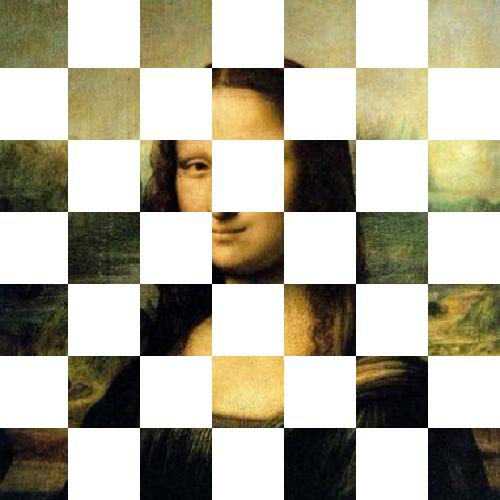
Name this famed work of art: 


Unless you're from another planet, you can fairly easily recognize it as the Mona Lisa. 

I'm a firm believer in the idea that you don't need all the pieces to recognize the big picture.  I often have lots of questions and doubts about God, but this is when I need to step back and focus on what's clearly there. #religion

Psychic patronage
There's a psychic on my way home from work every day (and they knew I'd be writing about them -- they're psychic).  It's a little building on the corner of two fairly busy streets.  It's been there forever.  There's always a car in the parking lot, and the sign is always lit up.  I'm a Christian, and I admit that Christianity has some ridiculous beliefs.  But I'm aware of the existence of more than one Christian.  I know some Jews, some Hindus, maybe a Muslim or two.  The point is that despite the unbelievability of major world religions, there are more than a handful of people who subscribe to each, and even I, as a socially awkward loner, know some of them.  Yet I don't know a single human being who has ever been to a psychic.  So my question is this:  How does this place stay in business?  I guess I could always ask a psychic. #religion

Godchange
I believe that God is in the business of changing people, not circumstances. #religion

Fear vs. faith
Fear can be defined as "believing what hasn't happened yet will definitely come true."  We fear spiders because they're creepy crawlies and sometimes poisonous.  We fear plane crashes because there's no way to survive them. 

Oddly enough, faith can be defined in the exact same way. #religion

Seeking God
If you look for the hand of God in something, you'll find it.  If you look for the hand of something else, you'll find that as well.  It's all about what you're looking for. #religion

Rocks (1)
Yesterday I was digging a hole in the "dirt" in my yard to make way for a compost pile.  I say "dirt" because it's really just a collection of rocks with sparse amounts of dirt mixed in.  Actually, I have a sneaking suspicion that the entire state of New Jersey is just one big rock, covered by a scant few inches of topsoil. 

So anyway, I was digging rocks out of the ground, when suddenly I hit a big one.  I spent the next hour or so unearthing the largest rock I've ever moved.  It was the heaviest object I've ever encountered in my life, made heavier by the fact that it was two or three feet down.  The thing is, it wasn't that big of an object, maybe two feet by one foot by one foot.  But it was deceptively heavy, and it was deceptively big.  It was quite a showdown, even for my favorite tool in the world, my slate rod

Fast forward to this morning, and what do I read in my morning Bible reading?  Psalm 62, which compares God to a rock.  The questions that go along with the reading asked me to "reflect on the specific characteristics of rocks and how they describe God's character."  Another God coincidence if I ever saw one.  My answer was easy to come up with:  Rocks are hard, and rocks are big.  You use rocks to build things on top of, like building faith on top of something that won't change or go away.  And rocks are often like the tip of an iceberg; i.e. there's more to God than what we see or know. 

Thinking about it further, I've noticed that many of the wonders of the natural world I've been fortunate enough to witness have something to do with rocks.  The iron-red mountains in Zion National Park are just big rocks.  The hoodoos of Bryce Canyon are rocks eroded by wind and water.  The Grand Canyon is sort of the absence of rock, though it's surrounded by giant walls of the stuff.  Islands are just rocks in the middle of water.  Volcanoes are rocks that used to be liquid.  Coral reefs are pretty much just rocks covered in stuff that attracts fish.  And all these rock things make me thank God for the beauty of nature. 

It's almost ridiculous how much God-stuff I can squeeze out of one simple series of events, but sometimes that's how it happens. 

One final thought about God and rocks:  Liquid Church did an excellent series called "Rock God" which was about discovering and experiencing God in music.  The first part was about music from the 60s through today and the second part focused solely on the 80s. #religion

God coincidences (2)
As someone with a basic knowledge of probability, I know that if I pick a colored ball from a bucket of variously-colored balls, then pick another colored ball from a different bucket of variously-colored balls, there's a certain probability that both balls will be the same color.  This probability increases with more buckets, and increases even more with fewer ball colors.  It's not rocket science.  It's how things like Blackjack and the lottery work. 

Nonetheless, I'm still amazed when I manage to hear or learn something about God and then rehear/relearn it in a different setting with little time in between.  The most recent example was about personal pain and suffering, and how we have a tendency to look for a cause or a cure when we should instead be looking for a purpose.  It was the main message behind a series of sermons at one church, then it was mentioned the following week at an entirely different church, then I read it in my personal Bible study.  It's hard for me to call that a coincidence. #religion

Friggin pastor
A few weeks ago, the pastor at my church used the word "friggin" during a sermon.  Part of me didn't even flinch when I heard it.  I don't mind language like that and I wouldn't mind hearing more of it from Christian (and worldly) leaders because I think it conveys a certain amount of emotion and is a relevant way to do so.  However, another part of me cringed because I remembered why Christian leaders aren't supposed to swear or do anything else bad:  Kids are watching.  Sure enough, a kid was sitting directly in front of me, and perhaps it was just a coincidence, but right after the pastor said the word, the kid leaned over to his mom and said something, to which his mother responded strictly.  This is merely speculation, but he could've said, "Mom, he said friggin," to which the mom might've replied, "Yes, but we don't use that word."  Right there, the mother is at a significant disadvantage, because pastors are often viewed as moral equivalents to God.  If the pastor uses the word "friggin," it trumps the mother's request to refrain from it, which means it's ok to use it.  And thus completes the perfect example of why pastors shouldn't use words like friggin. #religion

All-powerful God and logic
Most Christians believe in an omnipotent, or all-powerful, God.  Regardless of whether there really is a magical mystery man in the sky, the story goes like this:  He created the universe, parted the Red Sea, brought the dead back to life, etc.  As his title states, he's all-powerful, meaning there's nothing he can't do.  This particular aspect about him is his trump card.  How did all those animals survive on Noah's ark without their usual nourishment (like plants and other animals)?  Who knows, but God is all-powerful, so by definition, he could make it happen.  How did Jonah survive in the stomach juices of some big fish for several days without being chewed up or dissolved in the process?  Who knows, but an all-powerful God could make it happen. 

I bring up this fact at pretty much every Bible study I go to and every spiritual discussion I have.  I'm like Rain Man:  I focus on one simple detail and don't let it go.  Last night's example was about a coincidence.  If one person didn't happen to take the Saturday night shift on a whim two years ago, would he have met the girl who would later become his wife, who would encourage him to join a Bible study, the members of which are currently sitting in his living room?  The quick answer is that there's just no way the two would've met under normal circumstances.  Their paths wouldn't have normally crossed, and the girl was even planning on leaving the state for good in a few days.  It was a total coincidence that they met, and that a few years later, there would be a group of people discussing it on a Thursday night. 

But here's the trump card that, if you believe in an all-powerful God, you can't ignore:  If God is who we think he is, why do we always put limits on what he can and can't do?  Isn't he all-powerful?  Isn't he bigger than what we give him credit for?  Just because something is implausible, does that mean it's impossible for an everything-possible God?  The answer, logically, is no.  Since God is omnipotent, anything is possible.  Somehow or other, if it was part of God's plan, these two people would have met, gotten married, joined a Bible study, and invited us over last night.  It's like the Lost version of time travel:  You can't do anything to change what will happen.  Unfortunately that opens the can of worms dealing with free will, which is farther than I wanted to go with this. 

All this God stuff is hard to believe, but let's at least remember logic. #religion
Christmas vs. Easter (2)
I've always felt that Christmas is an overdone holiday.  Sure there's the consumerism and selfishness and all that stuff.  But in religious terms, the death of Jesus Christ (Easter) is far more important than the birth (Christmas).  Of course, without the birth, there would have been no death.  But that's circular logic.  The point is that the death of Jesus Christ allowed for the salvation of all mankind.  That's the event we should be celebrating.  Not some inaccurate estimation of his birth date. #religion