Taxpayer receipt
The think tank Third Way suggests (via PDF, which is an extremely stupid way to convey information on the internet IMO, but alas) that the federal government should supply taxpayers with an itemized receipt to show how much of their money went to which government-funded causes.  Top of the list:  Social Security.  Translation:  We need a national age limit.  (via Ezra Klein via On The Media)

Update:  Ask and ye shall receive:  Official Federal Taxpayer Receipt #money

Swipe-free credit card
My credit card company sent me a thing in the mail that works the same as a credit card except you don't have to swipe it.  Instead you just wave it in front of a magnetic or infrared reader.  And it's tiny so it fits on your keychain, or it can come with an adhesive back so you can stick it to your cell phone.  The problem is that this method of payment isn't accepted everywhere, i.e. merchants have to buy a special swipe-free credit card reader, and it's not nearly as ubiquitous as a traditional credit card reader.  So while it's convenient because you don't always have to bring your wallet with you, you have to know whether or not a store accepts swipe-free payments, which means you're better off bringing your wallet with you just in case, which makes the swipe-free payment tag completely useless. #money

Unnecessary expensive habits
I work with a guy who once proclaimed he spends about $150/month on Scotch, which he seemingly believes makes him $150/month more cultured and sophisticated.  Call me a cheap, close-minded simpleton, but that's a habit I don't see myself starting. #money

Affording loss
There's an article from the St. Petersburg Times (FL) about strawberry farmers being forced to let fruit rot because harvesting them isn't worth the cost of selling them.  That's bad and all, and waa waa we all cry for farmers and whatever, but that's not the point.  The writer of the article chose to use the following sentence towards the end: 
It might seem wasteful, but they explain that if they pick for such low profits, they'll lose money. They can't afford to do that -- especially after such a bad season.
The question is, when can anyone "afford" to lose money? #money

Human salary cap
One of my work associates was ranting about the immense wealth of Warren Buffett and suggested that he step aside and let somebody else give it a try.  I mentioned that Buffett is fairly good at whatever it is he does, seeing that he's consistently ranked as one of the top three richest humans on the planet.  My associate suggested the idea that perhaps someone could do an even better job, but we'll never know one way or the other because successful people are rewarded with the option to continue doing what they're doing, which isn't a bad thing, but which certainly diminishes the chances that another person will get a similar opportunity.  So he suggested we implement a salary cap for human beings.  Say $10 million.  Once you make $10 million, you're out of the game.  We'll appreciate you and pat you on the back, but now it's your turn to step aside and give somebody else the reins.  I think it's a pretty good idea, so you can count me in:  I promise to quit doing what I'm doing once I make $10 million. 

Twenty minutes later, the guy comes back and says, "Better play it safe and make it $100 million." #money

Stimulus result
The Onion reports on the results of the $787 billion federal stimulus package from a year ago.  One of the line items:  "$2.2 million: Widened the National Debt Clock."  Har har. #money

Gift exchanges
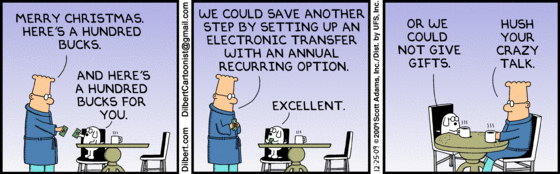
I like the idea of a gift exchange:  You pick a name from a hat and buy a gift for one person who's usually part of a larger group.  It's a good way to be involved in the tradition of giving gifts for Christmas but without feeling obligated to buy gifts for everyone in the group.  The problem is that I don't like how it always turns out:  We don't want to buy a person stupid meaningless gifts, so we ask them what they'd like, and since most people don't know what they want or don't feel like explaining in detail the exact thing they have their mind set on, they request a gift card so they can buy it themselves.  In other words, it's a gift of money.  But since the giver receives something in return, usually in the same price range and usually a gift card to a different store, it's an exchange of money with zero net effect.  If anything, it makes things more difficult because your money is now in a slightly difficult-to-use format.  And it's not that I don't like gift cards.  It's more just that I have trouble rationalizing my participation in a fruitless exchange of currency. 

Related: 
[Image: grinchshirt.jpg]
Also related:  This Dilbert comic #money

Cruise financials (2)
Cruise companies exist to take your money.  It's something that's easy to forget.  They try to make it seem like they want you to have a good time, what with all their food and music and fun things, but really they just want your money.  It's not like they do this stuff for the good of mankind.  Here's how they do it: 
  1. You pay for the cruise months before you leave, so by the time you step foot on the ship, you can't really remember how much it cost.  This is good and bad.  Good because you don't have to worry about how you'll afford things, because you already paid for it.  But bad because you easily forget that you already paid many hundreds or thousands of dollars, so you don't think twice about all the little add-ons mentioned below.
  2. You pay for excursions, which aren't a bad investment because the cruise people plan everything and take care of the details.  But it's an additional, often substantial, cost.
  3. They charge for things like soda, alcohol, and fancy restaurants on the ship.  These charges can be avoided, but what's a vacation without at least a little alcohol?  And they have these silly little drink specials where you can get 6 beers for the price of 5 (at $5 a beer) and a margarita discounted from $12 to $8.  In other words, they have crappy drink specials, but you're not allowed to bring your own alcohol on board, so what can you do.
  4. Auto-gratuity is a cute little word that shows up on the bill for drinks that simply means "forced tip."  You don't have a choice.  They take it automatically, for your "convenience."  How thoughtful.
  5. When you check out on the last day, you find out that you're required to pay a daily tip.  They "conveniently" tack that onto your account, and at $12 per day per person for a 14-day cruise, that suddenly becomes a significant additional charge.  My thing is, I'd rather be charged up front than in the rear, and the double meaning of that phrase is not lost on this example.  I just think it's very shady to convince people that their entire vacation is already paid for (minus drinks and fancy restaurants) and then, BAM, you owe us a ridiculous tip too.
Ah, capitalism. #money

Buying drinks
I have this problem whenever I order a drink at a restaurant or bar where I can't stop calculating how much cheaper I could do things if given the opportunity.  Let's say I get a pint of Yuengling for $5.  Being a capitalist, I know I can buy the exact same quantity of beer in bottle form as part of a six-pack for approximately the same price I'm being asked to cough up for just one.  And it kills me.  I'm forced to rationalize the fact that it's on tap so it's likely fresher, or that I'm spending time with other humans which is good for me.  This is part of a much larger problem of mine where I feel irrationally compelled to get the most for my money.  Poor me, pour me a drink. #money

Car store
I think it's weird that in our capitalist country, we still go to a car dealership where we shop for a certain size car of a specific brand, as opposed to going to a car store where we might shop for a specific brand car of a certain size.  I realize there are complicated car company and dealership incentives involved, so it probably wouldn't make financial sense for a dealership to carry several car brands.  And I realize that things like the Apple store exist for the purpose of selling a single brand, and they do quite well.  But I still find it odd that I have to go to a Toyota store, look at the Toyota products, then drive across town to the Honda store to compare the Toyota products to the Honda products, then drive over to the Ford store and compare all three.  It would be much easier (for me) to just go to my local car store, peruse the various offerings by Toyota, Honda, and Ford, and make my decision.  To make it easier and more affordable for dealers, they could have separate stores for cars, trucks, and minivans, since customers typically don't go in to buy a car and come out with a truck. #money