Mathematical oddity (5)
Does 0.99999... (0.9 repeating) equal 1?  Most people think so.  And this guy proves it.  I think the best proof he provided was this: 
10x = 9.9999999999...
- x = 0.9999999999...
---------------------
 9x = 9
  x = 1 = 0.9999999999...
The awesome part about this little mathematical oddity is that people get really mad about it and ferociously fight to explain their point of view.  I personally think we should burn at the stake anyone who doesn't agree.  At least I'm not angry about it.  (via Digg) #math

Pi Pie
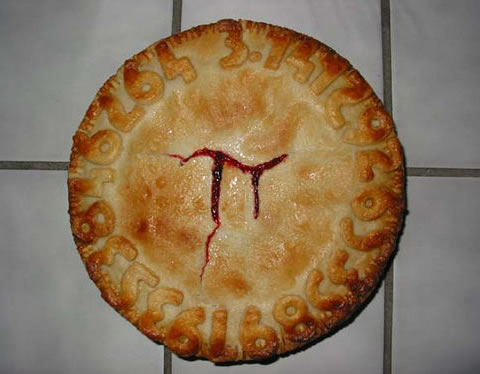
The Pi Pie pictured below is a cherry pie with a cutout of the mathematical symbol pi in the center and the first 23 digits engraved around the crust (some of the 5s and 2s are backwards).  It was made on Pi Day, which is March 14 (3/14). Flickr has more pictures of Pi Pies.  Finally!  Another entry in the math category!  (via Neatorama)
#math

The record (3)
When I was a 3rd-grade student at McKeown Elementary School, they used to teach us multiplication and division the right way:  Memorization of tables.  I don't remember exactly how they taught it (like was it the same thing every day or did we count M&Ms some days?), but I remember learning a certain number at a time.  For example, we'd focus on the number 7 by listing the product of 7 and every number up to 10.  7x1=7, 7x2=14, 7x3=21 ... 7x10=70.  Then we'd go to the next number and do the same thing.  I think we did every number from 1 to 10; 11 and up get complicated. 

The part that I disagreed with was the testing method.  They used this thing called "the record", which was literally a vinyl record with a person saying, "5 times 6 ...  3 times 8 ...  7 times 2 ..." while the students feverishly filled in the answers on their sheet.  There were several variations of the record:  One variation focused on certain numbers, depending on how many multiplication tables you had learned.  The other variation was in the speed at which the person spoke.  Some records used a 5 second pause.  Others used a 3 second pause.  Still others used an even shorter pause.  Obviously, the shorter the pause, the harder the test. 

The reason I disagree with the record as a testing method is because of the trauma is caused in the lives of the students.  The record was continuous:  Once it started, it didn't stop until the end.  If you missed one, you had to forget about it and move on.  Sure that sounds easy for a "grown-up" like me, but it's not the same with 8-year-olds.  There's this weird thing that happens when people feel overwhelmed.  It's called a "meltdown".  There was a meltdown during every one of these tests.  Halfway through the test, a kid would burst into tears because they lost their place or couldn't keep up.  But the teacher never stopped the record.  Like I said, once it started, it didn't stop until the end.  So some poor kid would sit there sobbing because there was no way to figure out what number the record was on.  It didn't say, "Number 3:  5 times 6 ... Number 4:  3 times 8 ..."  And since it was just multiplication or division, there was no partial credit.  There was no "almost" or "close".  It was right or wrong.  There's nothing like telling a kid they failed because they're too slow at multiplication.  Ah, the joy of being a teacher. 

The record needs to be experienced to be fully understood.  My explanation of it can't possibly do it justice.  Talk to any McKeown School student from the 80s-90s, and they'll know what I'm talking about.  With utter fear in their voice, they'll say, "Oh yes ... I remember the record ..." #math
Mathematical photography
This website is a collection of mathematical photography, which is basically just framed pictures of equations.  You have to be a special kind of person to like this stuff.  (via Boing Boing) #math

Marriage DNE kids
DNE is math terminology for Does Not Equal.  Actually, it really means Does Not Exist, but that doesn't apply to my statement.  Marriage ≠ kids.  Or marriage != kids.  Nya!  [Pushes up taped glasses] [Surrenders lunch money upon request]

My least favorite thing about being married is that everyone assumes that marriage equals kids.  I feel quite a bit of pressure concerning this.  When you're dating, no one asks, "So are you thinking about kids?"  There's still that unwritten taboo that having kids out of wedlock is somehow wrong.  But as soon as you're married, that's all anybody talks about.  "Any buns in the oven?"  No.  I just graduated college.  I just spent 80% of my life in school.  I've had no time to be myself.  Now you expect me to care for another human being?  A human being that can't control its bowel movements?  And I just got married.  Can't I have a little time to enjoy being a young married person?  With no kids?  I understand the argument that kids come from marriage.  That makes sense.  But give me some time.  C'mon.  I'll have kids as soon as I grow up. #math

Changing times (2)
Times they are a-changin'.  I got a call from a telemarketer last night at around 8:15 pm.  Back in the old days, they used to call at around 5 or 6 pm, which used to be called "dinner time".  Now they call at around the time when a lot of people get home from work.  Thankfully I'm not one of those people.  I'm more than happy with my 40 hours a week.

Fine, I'll say it.  How 'bout them gas prices?  High enough for ya?  Just as a point of reference:  When I started driving in 1999, it cost me about $10 to fill up the 10-gallon gas tank in my little tiny 4-cylinder 1990 Toyota Corolla.  It was around that time that gas was less than $1 per gallon.  It turns out that gas cost about $1 per gallon in 1980 as well.  Over a 20-year time period, the price went up a few cents and down a few cents, but stayed mostly around $1.30 or so.  Yesterday I got cheap gas.  It was $3.19/gallon.  So in the past 5 years alone, the price has gone up 319%.  But $3.19 is a small price to pay for a gallon of anything.  A gallon of orange juice costs about $3-$4 per gallon.  A gallon of olive oil costs about $30-$40 per gallon.  A 20-oz bottle of water costs about $1-$1.50.  A 1-gallon bottle of water costs about the same.  Too bad our cars don't run on water.  There's an unlimited supply of that.  Yeah, tell that to the people in Saharan Africa. #math

Brake
So it turns out that I have a problem with people who overuse their brakes while driving.  [I know, I know.  Am I happy with anything?]  I don't see the point in slowing down if there's really no reason to slow down other than to obey the speed limit, especially when gravity will cause you to slow down anyway.  For example, there's a hill on Route 10 near Ledgewood that's pretty steep.  The speed limit is 50 mph.  Coasting down the hill usually brings me to about 65 mph.  At the bottom of the hill, the car begins to slow back down to normal speed.  Yet people insist on wasting their brakes by maintaining a steady 50 mph all the way down the hill.  Here's my justification for not braking:  by not applying my brakes, I'm saving brake fluid and other related car parts.  In addition, I'm saving some ever-increasingly-expensive gasoline by eliminating the need to accelerate once I've reached the bottom of the hill.  By using the speed gained from going down that hill, I can coast for miles.  Think of how much gas could be saved by using energy generated by momentum.  Uh oh...random math proof:  let's say I can coast for a solid (1) mile with the momentum gained from coasting down the hill.  Let's say my car gets 25 miles per gallon.  Let's also assume that my car uses no gas when coasting (this is obviously not true, but it is true for hybrid cars).  So if I coast for that 1 mile without using the gas pedal, I will have saved 1/25 (0.04) gallons of gas.  Let's assume gas is $2 per gallon.  That's a savings of $0.08.  Not too much.  Now apply that to rush hour traffic.  Let's say 100 cars do this exact thing.  That's a savings of 4 gallons of gas, which amounts to $8.  To make it even more realistic, let's say that 500 cars do this exact thing every day for 1 month.  That's 500 cars x 30 days x 0.04 gallons, which is 600 gallons of gas, which amounts to $1200.  Now we're talking. #math

Age (1)
Hypothesis:  The older you get, the faster time goes by. 

Explanation:  The first day you're born lasts 100% of your life up to that point.  The second day you're alive lasts 50% of your life up to that point.  This pattern continues, and it works out that every day of your life is equal 1/n of your life, where n is how many days you've been alive.  So when I was 5 years old, I had been alive for ~1825 days.  The day of my birthday was 1/1825 of my life.  Let's make it even easier by using years.  When I was 5 years old, the time between my 3rd and 4th birthdays was equal to 1/5 of my life, or 20%.  When I was 20, the time between my 3rd and 4th birthdays was equal to 1/20 of my life, or 5%.  So when I'm 100, the time between my 3rd and 4th birthdays will be equal to 1/100 of my life, or 1%.  A day when I was 2 lasted for 0.137% of my life.  A day when I was 20 lasted for 0.0137% of my life. 

Conclusion:  The older you are, the smaller of a percentage of your life is taken up by an equal amount of time.  Therefore, you can't say, "This has been the longest day of my life."  It's just not true. #math